
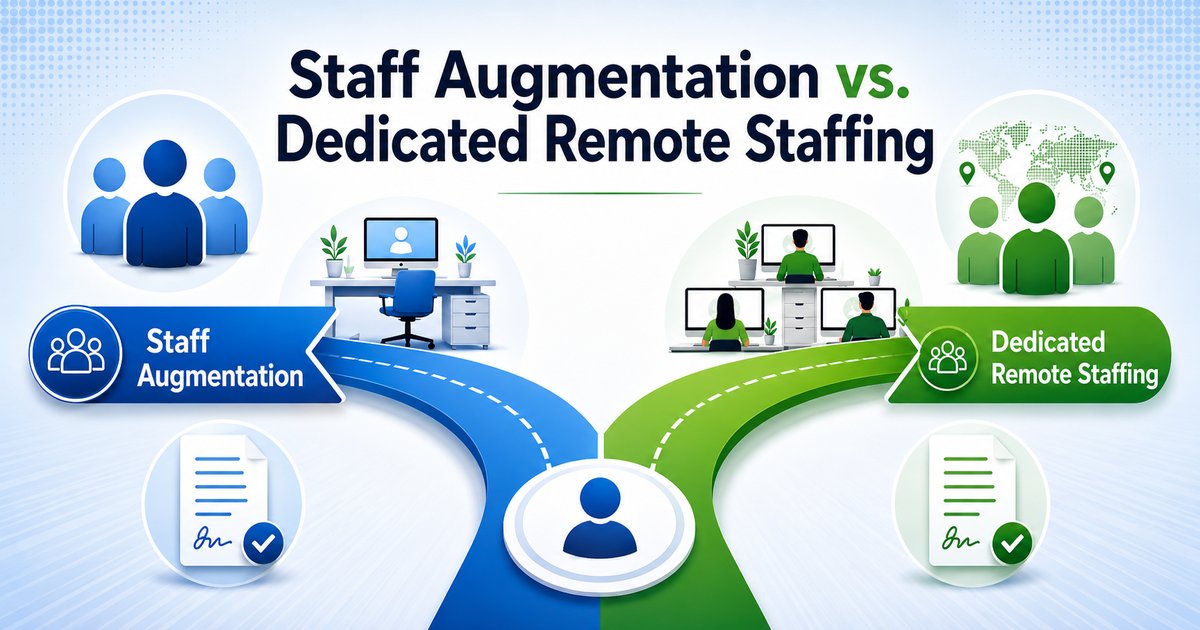
Staff Augmentation vs. Dedicated Remote Staffing: Key Differences Every US Business Owner Should Know

What Is Staff Augmentation?
Staff augmentation is a flexible outsourcing strategy where a business temporarily supplements its existing in-house team with external professionals, typically sourced through a staffing vendor or agency. These professionals — often developers, designers, QA engineers, or data analysts — work under the direction of your internal managers, plugging specific skill or capacity gaps for a defined project or time period.
Think of staff augmentation as renting talent. You identify a gap, the vendor fills it, and when the need dissolves, the engagement ends. This model is especially popular in the technology sector, where project timelines fluctuate and niche skills like React.js, Python, or DevOps are hard to source locally on short notice.
Common Use Cases for Staff Augmentation
- Adding developers to an existing Agile sprint team mid-project
- Filling in for a key employee on leave
- Sourcing specialized skills (e.g., AI/ML engineering or DevOps) for a short-term initiative
- Scaling up for a product launch or seasonal demand spike
- Supplementing a team during a hiring freeze
Staff augmentation services are commonly delivered on a contract basis — monthly, quarterly, or project-based — and the augmented staff typically remains on the vendor's payroll, not yours. This limits your HR overhead but also limits your control over talent continuity.
What Is Dedicated Remote Staffing?
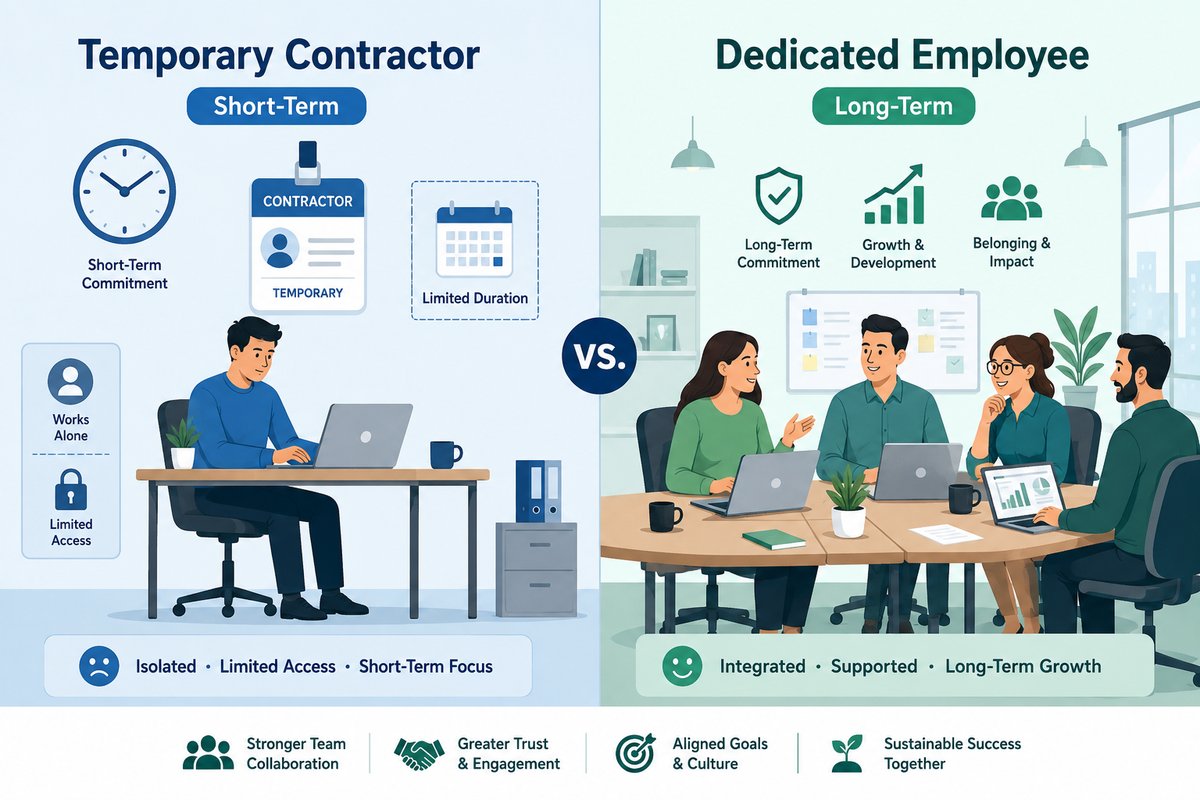
Dedicated remote staffing — sometimes called a dedicated offshore team model — is a longer-term arrangement where you hire full-time remote professionals who work exclusively for your business, typically based in a cost-effective location like India. Unlike project-based outsourcing or temporary staff augmentation, dedicated remote employees are integrated into your company culture, reporting structures, and daily workflows just like any in-house hire.
The key word here is dedicated. These are not shared resources split across multiple clients. A dedicated remote developer, marketer, or virtual assistant works only for you — 40 hours a week — on your tools, your processes, and your goals.
Common Use Cases for Dedicated Remote Staffing
- Building a long-term offshore development team to support your product roadmap
- Hiring a full-time SEO expert or content writer at a fraction of US hiring costs
- Staffing an entire offshore department (e.g., customer support, data entry, accounting)
- Replacing expensive local contractors with cost-efficient, full-time offshore equivalents
- Scaling your team permanently without the overhead of local employment
This model is ideal for businesses that want more than a quick fix — they want a reliable, scalable talent strategy that grows with their company.
Ready to build your team?
Pre-vetted resumes in 48 hours. Free interviews, no obligation.
Hire Talent Now →
Staff Augmentation vs. Outsourcing: Key Differences Explained
The phrase "staff augmentation vs outsourcing" is often used loosely, but there are meaningful structural, financial, and operational differences between these models. Here's a clear breakdown:
1. Control and Management
In staff augmentation, the client business manages the day-to-day work of augmented staff. The vendor handles payroll and HR. In traditional outsourcing, the vendor manages the team and delivers outputs — meaning you have less visibility into how work gets done. Dedicated remote staffing sits closest to staff augmentation in terms of control: you manage the person directly, but the staffing provider handles compliance, payroll, and HR admin.
2. Duration and Commitment
Staff augmentation is inherently short-to-medium-term — often project-based or rolling monthly. Dedicated remote staffing is built for the long haul, with professionals embedded into your team for months or years. Traditional outsourcing is often milestone- or output-driven, with no expectation of ongoing headcount.
3. Team Integration
Augmented staff integrate into existing teams temporarily. Dedicated remote professionals integrate permanently — attending standups, using your Slack, following your onboarding process, and building institutional knowledge over time. This makes staff augmentation less suitable for roles that require deep context or ongoing relationship-building.
4. Talent Ownership
With staff augmentation, the talent belongs to the vendor — they may be placed with another client if your contract ends. With dedicated remote staffing, while the professional is on the vendor's payroll for compliance purposes, they are functionally your employee: exclusive, loyal, and incentivized to grow with your business.
5. Cost Structure
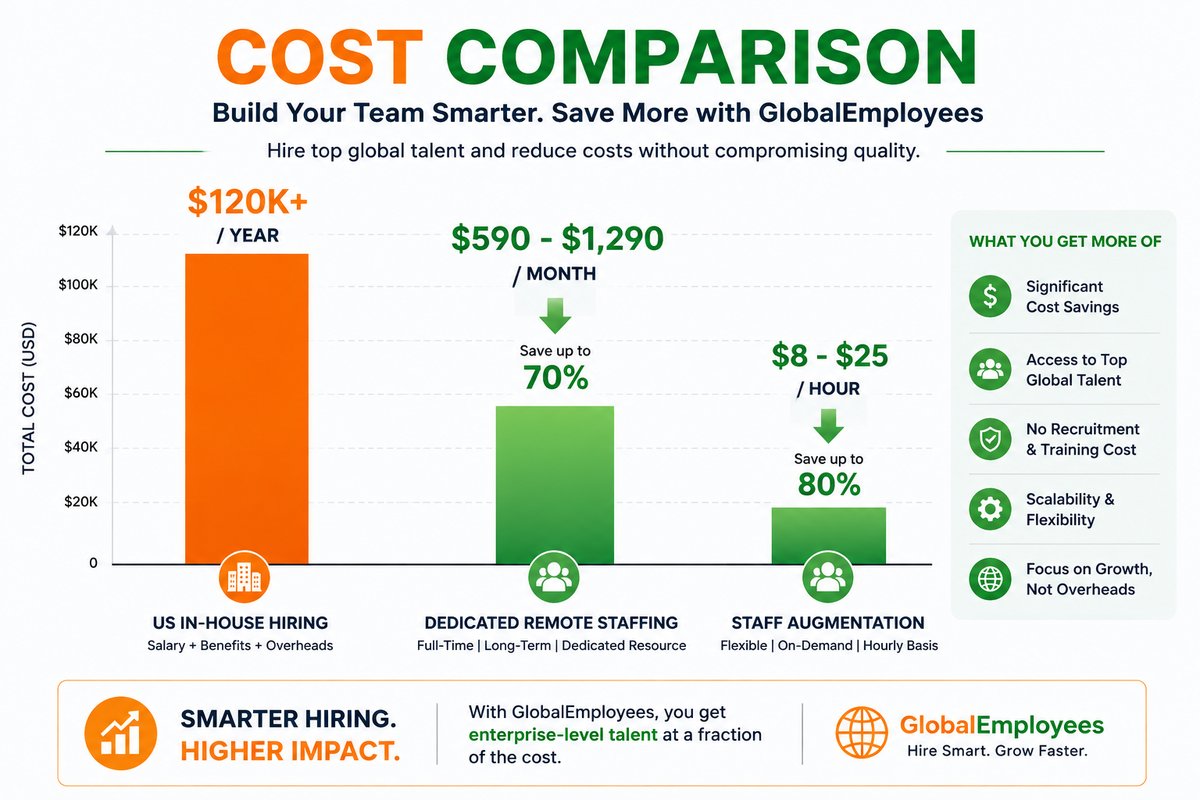
Staff augmentation services typically charge a premium for flexibility — you pay for the convenience of on-demand access. Dedicated remote staffing offers lower per-hour effective rates because you're committing to a full-time engagement. For US businesses, this often translates to savings of 50–70% compared to equivalent local hires.
| Factor | Staff Augmentation | Dedicated Remote Staffing | Traditional Outsourcing |
|---|---|---|---|
| Duration | Short to medium-term | Long-term / permanent | Project-based |
| Management | Client-managed | Client-managed | Vendor-managed |
| Exclusivity | Shared resource possible | 100% dedicated | Shared team common |
| Cost | Higher (flexibility premium) | Lower (full-time rate) | Variable |
| Cultural Integration | Partial | Deep | Minimal |
| Best For | Skill gaps, surge capacity | Scaling, long-term growth | Defined deliverables |
Pros and Cons of Each Model
Staff Augmentation: Pros
- Speed: Get skilled professionals onboarded in days, not months
- Flexibility: Scale up or down without long-term commitments
- Control: You manage the work directly, just like in-house staff
- No recruitment overhead: The vendor sources and vets candidates
Staff Augmentation: Cons
- Higher effective cost per hour: Flexibility comes at a premium
- Talent attrition risk: Augmented staff may be reassigned by the vendor
- Limited loyalty: Temporary workers have less incentive to invest deeply in your company
- Not suitable for leadership or strategic roles
Dedicated Remote Staffing: Pros
- Cost efficiency: Full-time offshore rates are typically 50–70% lower than US equivalents
- Deep integration: Remote employees become true team members over time
- Exclusivity: No sharing — your hire works only for you
- Scalability: Easily add multiple roles across departments
- Knowledge retention: Institutional knowledge builds over time, improving quality
Dedicated Remote Staffing: Cons
- Longer onboarding: Full integration takes more time than plug-and-play augmentation
- Management responsibility: You direct the work, so internal management capacity matters
- Time zone coordination: Requires planning for async or overlap-based workflows
Which Model Is Right for Your US Business?
The right choice depends on your business goals, timeline, and the nature of the role you're filling. Here's a practical framework to guide your decision:
Choose Staff Augmentation If:
- You need to fill a gap for a specific project with a defined end date
- Your in-house team needs temporary capacity during a growth sprint or seasonal surge
- You need a niche skill — like a Salesforce developer or React developer — for 2–6 months
- You want minimal HR overhead and maximum flexibility
Choose Dedicated Remote Staffing If:
- You're building a function or department that needs to scale over time
- You want to reduce payroll costs permanently without sacrificing quality
- You need roles like digital marketing experts, graphic designers, or data entry operators on a full-time basis
- You want employees who grow with your company, not contractors who move on
- You're a small or mid-sized US business that can't afford local full-time hires for every role
For many US businesses — especially startups, SMBs, and fast-growing e-commerce brands — dedicated remote staffing offers the best long-term value. It combines the control of in-house employment with the cost efficiency of offshore staffing.
Cost Comparison: Staff Augmentation vs. Dedicated Remote Staffing
Cost is one of the most decisive factors for US business owners comparing these two models. Let's look at what the numbers typically look like in practice.
According to industry benchmarks, a mid-level software developer in the US commands a fully-loaded cost (salary + benefits + taxes + recruiting) of $120,000–$160,000 per year. Staff augmentation services for a comparable contractor commonly run $80–$150 per hour, which at 40 hours/week translates to $166,000–$312,000 annually — often more expensive than a direct hire once you account for agency markups.
Dedicated remote staffing through a provider like GlobalEmployees, by contrast, typically costs $590–$1,290 per month per employee — or roughly $7,080–$15,480 per year. Even for senior developers or specialists, this represents savings of 60–80% compared to US market rates, with no recruitment fees, no benefits overhead, and no long-term legal liability on your end as the employer of record.
Sample Cost Comparison Table
| Role | US Full-Time Cost/Year | Staff Augmentation (Contract) | Dedicated Remote Staffing |
|---|---|---|---|
| Mid-Level Developer | $130,000+ | $170,000–$200,000 | $10,000–$15,000 |
| Digital Marketer | $70,000–$90,000 | $60–$100/hr | $7,080–$12,000 |
| Graphic Designer | $60,000–$80,000 | $50–$90/hr | $7,080–$10,000 |
| Data Entry Specialist | $35,000–$50,000 | $25–$45/hr | $7,080–$8,500 |
These figures illustrate why growing businesses increasingly opt for dedicated remote staffing over traditional staff augmentation services when cost efficiency is a priority alongside quality and control.
How GlobalEmployees Fits Into Your Hiring Strategy
GlobalEmployees is a dedicated remote staffing company that helps US businesses hire full-time, pre-vetted professionals in India — combining the control of in-house employment with the cost benefits of offshore staffing. Unlike a traditional staffing agency that places temporary contractors, GlobalEmployees builds long-term hiring relationships where your remote employee works exclusively for you, every day.
Here's what the process looks like when you work with GlobalEmployees:
- Brief us on your role: Share your requirements, and within 48 hours you'll receive matched resumes of pre-vetted candidates
- Interview for free: No commitment until you find the right person — interviews are completely free
- Start with confidence: A 30-day money-back guarantee means zero financial risk on your first hire
- Scale as you grow: Add developers, designers, marketers, and support staff across roles as your business expands
Whether you want to hire developers in India for your tech stack, build out your marketing team, or staff an entire offshore department, GlobalEmployees provides a streamlined, transparent, and affordable path to remote hiring — with pricing starting at just $590/month per employee and no hidden recruitment fees.
If you're currently exploring your options and wondering whether staff augmentation or dedicated remote staffing is the better fit, the team at GlobalEmployees can walk you through a no-obligation consultation to help you decide. Learn how it works and get started today.
Frequently Asked Questions
What is the main difference between staff augmentation and outsourcing?
Staff augmentation involves temporarily supplementing your in-house team with external professionals who work under your direct management, while traditional outsourcing delegates an entire function or project to a third-party vendor who manages the work independently. Dedicated remote staffing is a hybrid that combines the control of staff augmentation with the cost efficiency of offshore outsourcing, giving you full-time remote employees who are exclusively yours. Understanding the staff augmentation vs outsourcing distinction helps you choose the model that best matches your operational style and long-term goals.
Is dedicated remote staffing the same as staff augmentation?
Not exactly. While both models give you control over the day-to-day work of remote professionals, staff augmentation is typically short-term and project-based, whereas dedicated remote staffing is designed for full-time, long-term employment relationships. Dedicated remote employees are exclusively assigned to your business, build institutional knowledge over time, and integrate deeply into your team culture — qualities that temporary augmented staff rarely develop. For US businesses looking to reduce costs without sacrificing quality or continuity, dedicated remote staffing is generally the stronger strategic choice.
How much can I save with dedicated remote staffing compared to hiring locally in the US?
US businesses typically save 60–80% on labor costs by hiring dedicated remote professionals in India compared to equivalent local hires. For example, a mid-level software developer in the US might cost $130,000+ per year in fully-loaded costs, while a dedicated remote developer through a provider like GlobalEmployees commonly runs $10,000–$15,000 per year with no additional recruitment fees or benefits overhead. These savings compound significantly when you scale across multiple roles or departments, making offshore staffing one of the most impactful cost-reduction strategies available to SMBs.
Which industries benefit most from staff augmentation services?
Staff augmentation services are most commonly used in technology, software development, e-commerce, healthcare IT, and financial services — industries where project workloads fluctuate and specialized skills are frequently needed on short notice. Roles like web developers, QA engineers, UX designers, and data analysts are among the most commonly augmented positions. That said, dedicated remote staffing is increasingly being adopted across these same industries for non-project roles like digital marketing, customer support, accounting, and content creation, where long-term continuity delivers more value than temporary flexibility.
Can I switch from staff augmentation to a dedicated remote staffing model?
Yes, and many US businesses make this transition as they recognize the cost and continuity advantages of having dedicated full-time remote employees over rotating contract staff. The shift typically involves identifying which augmented roles have become permanent needs, then replacing them with dedicated hires through a remote staffing provider. Providers like GlobalEmployees make this transition straightforward by delivering pre-vetted candidates within 48 hours and offering free interviews so you can evaluate fit before committing. The 30-day money-back guarantee also eliminates financial risk during the changeover period.
What roles can I hire through a dedicated remote staffing company?
A full-service remote staffing provider covers a wide range of roles across technology, creative, marketing, operations, and administrative functions. Common hires include software developers (React, Node.js, Python, PHP, Java, .NET), digital marketers, SEO specialists, graphic designers, content writers, virtual assistants, data entry operators, accountants, and customer support representatives. GlobalEmployees, for instance, supports hiring across all of these categories with pre-vetted professionals who are ready to integrate into your existing workflows. The breadth of available roles makes dedicated remote staffing a viable solution for nearly any department in your business.
How quickly can I hire a dedicated remote employee?
With an efficient remote staffing provider, the process is significantly faster than traditional local hiring. GlobalEmployees, for example, delivers matched candidate resumes within 48 hours of receiving your role brief, and you can begin interviewing shortlisted candidates immediately — at no cost and with no obligation. Most US business owners are able to onboard their first dedicated remote employee within one to two weeks of initiating the process. This speed, combined with the zero-risk 30-day money-back guarantee, makes it practical to move quickly without sacrificing due diligence.
Need to hire dedicated remote talent?
Get pre-vetted resumes within 48 hours — free consultation, no obligation.
Hire Talent Now